Getting started
Configuration wizard
HTML templates
JavaScript framework
Additional resources
- Video: Introducing Plumsail Org Chart
- Data caching
- SharePoint Server 2019/SE (On-Premises) resources
- Installation for SharePoint 2019 / SE
- Quick configuration
- How to add Org Chart to Microsoft Teams tabs
- Generate organization structure report
- Layout
- Filtration
- JavaScript custom code
- General settings
- Display assistants
- Display dotted-line managers for Org Chart
- Display vacancies
- Customize box HTML template and CSS styles
- HTML templating syntax
- Change Org Chart skin
- Create org chart with two root managers
- Order employees boxes using custom field
- How Org Chart pulls data from AD On-Premises
- Drill down to current user by default
- Drill down to specific box using URL parameter
- Include and use fields from additional list
- Use advanced Org Chart navigation
- How to open Org Chart in full-screen mode on load
- Support of search in a list with more than 5000 items
- Exclude disabled users in On-Premises
- Configuring profiles sync in On-Premises
- Make sure that SharePoint has enough data
- Exporting properties to a directory service
General
- Version history
- Licensing details
- Data protection and security
- Custom code security measures
- Billing and subscription management
Printing & Reports
- Printing organizational structure
- Generate multi-page PDF report
- Export to CSV and analyze in Excel
- Custom styles for printed Org Chart
Microsoft Teams
Display different types of employees
Filter and order boxes
- Create and manage filtered views
- Order employees boxes using a custom field
- Group employees boxes using a custom field
Customize boxes and styles
- Format boxes conditionally
- Customize box HTML template and CSS styles
- Display awards and conditionally format Org Chart
- Create an Org Chart with two root managers
- Change Org Chart theme
- Localize Org Chart
Show specific user on load
- Drill down to specific box using URL parameter
- Drill down to current user by default
- Drill down to manager of user from URL by default
Manage web part size and scale
- Open Org Chart in full-screen mode on load
- Make Org Chart use full page width
- Automatically scale boxes to fit visible area
Other examples
- How to customize Org Chart
- How to use advanced Org Chart navigation
- Use tenant properties to disable Org Chart features
- Include and use fields from additional list in Org Chart
- Support of search in a list with more than 5000 items for Org Chart
- Show Org Chart based on a list data source for anonymous users
- How to check if a user has Tenant Administrator permissions
General settings (SharePoint Server 2019/SE)
This step of the configuration wizard allows you to:
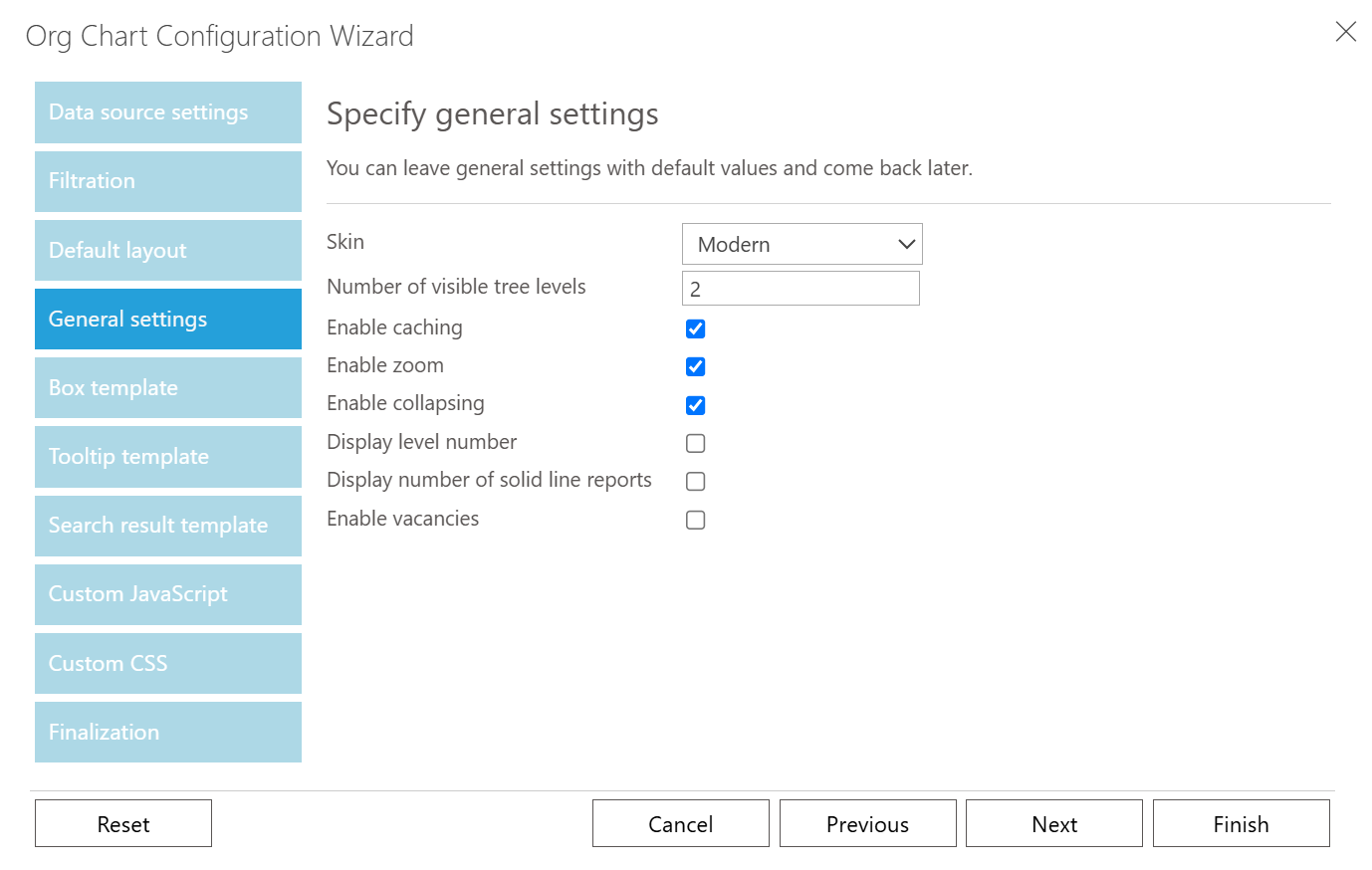
This is how it looks:
Choose predefined skin
To change the skin of the Organization Chart choose it from combo box. There are two skins adopted for mobile devices BlackMetroTouch and MetroTouch, they have large expand buttons to simplify touch navigation, all skins support dragging of the visible area with touch.
List of available skins:
Modern
Forest
Office
Sunset
Black
Glow
Office Black
Vista
BlackMetroTouch
Hay
Office Blue
Web 2.0
Light Gray
Metro
Outlook
Web Blue
Silver
MetroTouch
Simple
Windows 7
Silk
Set number of visible tree levels
You can also control a number of levels visible by default. Use input Number of visible tree levels to change it. You may expand all hierarchy tree by default, just set a value large enough in the input, for example 1000.
Note
this can affect performance of Org Chart on large structures.
Enable / disable zoom
You can use mouse wheel to zoom in and zoom out in the Org Chart web part. To disable/enable this functionality use Enable zoom checkbook.
Display employee level number
Also, you can display the level number in your hierarchy tree for each user by checking Display level number.
Display number of solid line reports
You can enable the feature for displaying the number of solid line reports for all users in your structure by checking Display number of solid line reports.
Configure vacancies
Note
If vacancies don’t appear in your web part try to clear cache. Also, vacancies are not supported in SharePoint 2010 version.
Vacancies are stored in a separate SharePoint list. A list will be created automatically at specified Vacancies list URL. Once you enabled vacancies Manage vacancies menu item will appear:
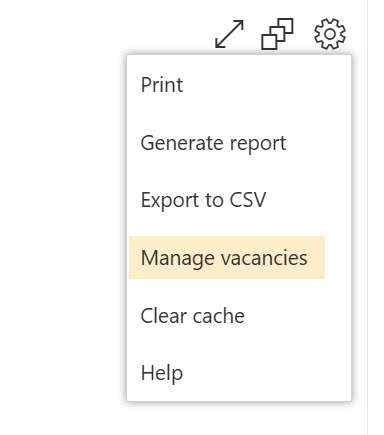
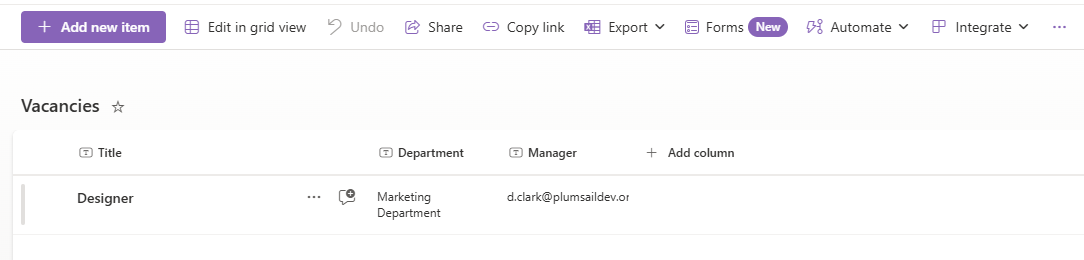
This menu item redirects a user to vacancies list. To create new vacancies, create new list item and specify Manager. It can be account name for User Profiles data source and list item ID for SharePoint list data source:
Note
Go to the next step of the configuration wizard – Box template.